
Ahmedabad · All India Network
Container Service in Ahmedabad for Industrial and Commercial Cargo
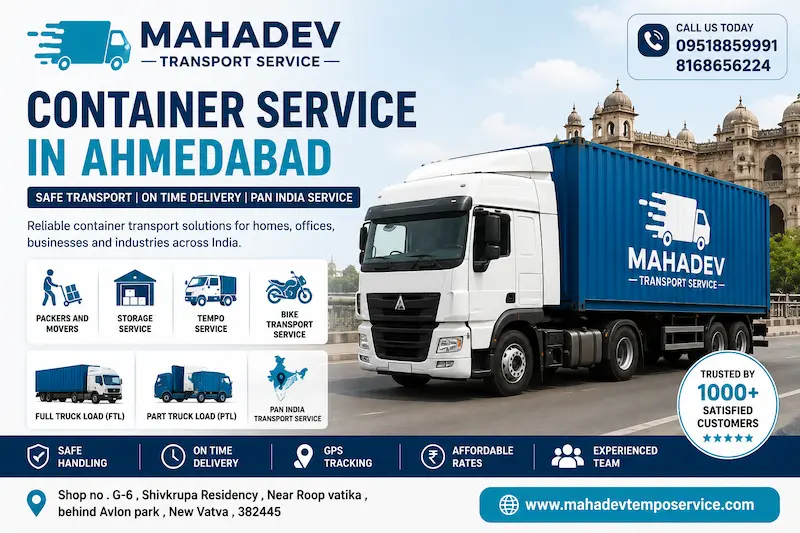
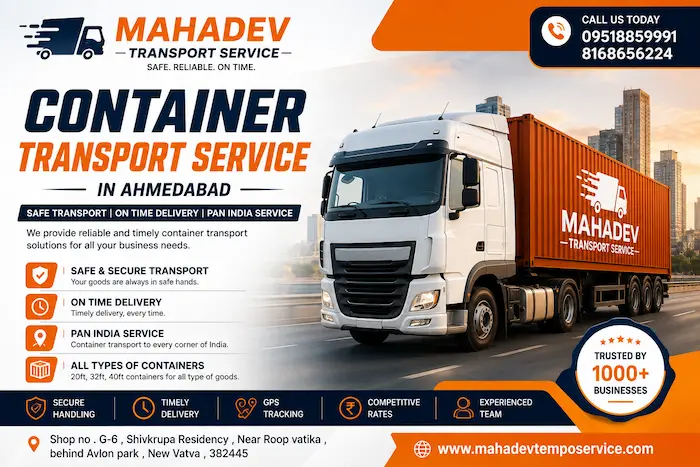
Mahadev Transport Service arranges 20ft, 32ft and 40ft container transport across Ahmedabad's industrial belt and interstate routes, with GPS-tracked vehicles, GST invoicing and a team that plans loading, lashing and documentation before the truck ever leaves the yard.
Get a Container Transport Quote
Share your route and cargo details. Our team responds with a quote, usually within 15 minutes during working hours.
Thank you
Thank you for contacting Mahadev Transport Service. Our logistics team will contact you shortly.
- GSTInvoice Available
- 24×7Open & Support
- GPSVehicle Tracking
- SafeDamage-Free Handling
- On-TimeDelivery Focus
- Pan-IndiaService Network
Last updated: August 2026
About Mahadev Transport Service
Mahadev Transport Service is based out of New Vatva, Ahmedabad, and works with factories, traders and warehouses across the city's industrial belt to move containerised cargo by road. The team coordinates container transport service in Ahmedabad for 20ft, 32ft and 40ft loads, handling everything from a single close body container booking to recurring factory-to-port movement.
Work is organised around three things that matter most to shippers: a vehicle that is tracked and accounted for from pickup to delivery, paperwork that is ready before the container is loaded, and a loading crew that understands how to lash and choke cargo so it survives Ahmedabad's industrial roads and long-distance highway runs without damage.
Rather than treating booking, loading and documentation as separate problems handled by separate people, the same team stays involved from the first enquiry call through to proof of delivery at the destination, which is what keeps miscommunication and last-minute surprises to a minimum.
Quick Glossary
A few terms used throughout this page, in plain language.
- FCL (Full Container Load)
- One shipper books and fills an entire container.
- LCL (Less than Container Load)
- Multiple shippers' cargo shares space in one container.
- Dunnage
- Packing material (wood, foam, air bags) used to fill gaps and stop cargo from shifting.
- E-Way Bill
- Mandatory electronic document for road transport of goods above a set value in India.
- Lashing
- Securing cargo with straps or chains so it cannot move inside the container in transit.
- High Cube Container
- A container with roughly one extra foot of internal height compared to a standard unit.
Our Transport Container Service in Ahmedabad
Container service in Ahmedabad is organised by container size and cargo type, so the right vehicle, loading plan and paperwork are matched to each booking rather than treating every shipment the same way. This is the most detailed section on the page — if you're deciding which container fits your cargo, start here.
What size container do I need for my cargo?
The short answer: it depends on volume, weight and whether the cargo needs to stay fully sealed. A 20ft container suits compact, dense industrial loads; a 32ft close body suits mixed commercial cargo that needs weather protection; a 40ft or 40ft high cube suits bulk or high-volume shipments. The sections below explain each in more detail so you can match your specific load to the right option.
SIZE 20FT
20ft Container Transport
A 20ft container carries roughly 28 cubic metres and suits shipments that are heavy for their size rather than bulky — steel components, machinery parts, packed cartons on pallets. It's the practical choice when a factory has a full truckload of dense cargo but not enough volume to justify a 40ft unit; using a 20ft here keeps freight cost proportional to what's actually being moved.
Loading is straightforward with a forklift or hand-loading crew, and because the box is shorter, manoeuvring it into tighter factory gates or narrower lanes in industrial estates is easier than with a 40ft unit.
The trade-off is limited to unusually large or lightweight cargo — items that fill the container's volume long before they approach its weight limit are usually better suited to a 32ft or 40ft option instead.
SIZE 32FT · CLOSE BODY
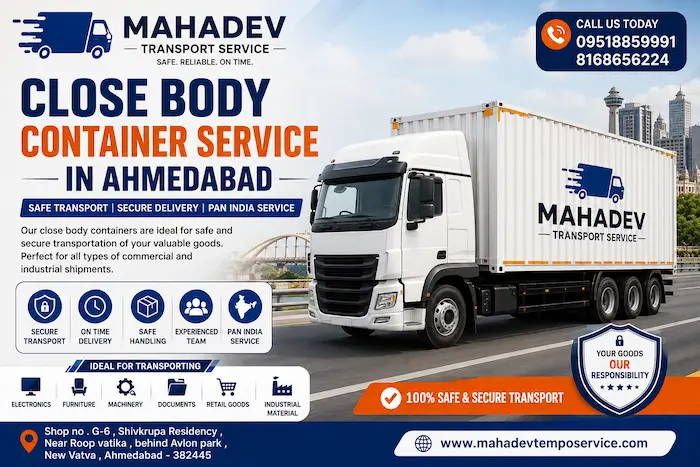
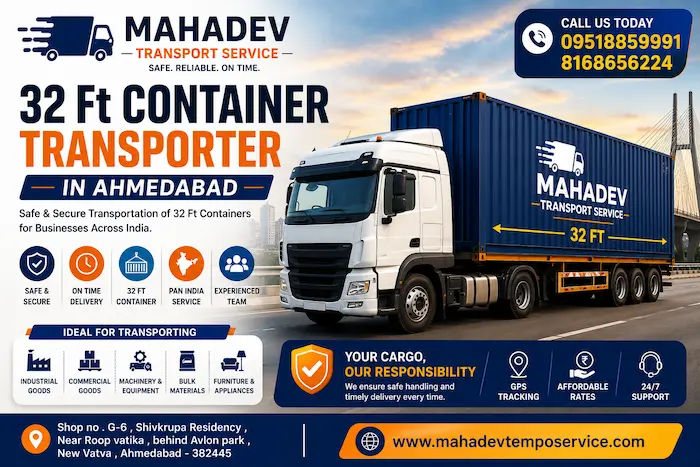
32 Ft Container Transport & Close Body Container Service in Ahmedabad
The 32ft close body container is one of the most booked options for container transport service in Ahmedabad, mainly because it sits at a practical middle ground: more volume than a 20ft, easier to manoeuvre than a 40ft, and fully enclosed so cargo stays sealed from weather, dust and pilferage for the whole trip.
It's a natural fit for mid-size machinery, mixed commercial cargo destined for multiple stops, textile bales, and FMCG or retail goods where the shipper wants the load out of sight and protected rather than riding on an open body truck.
Ideal customers are traders and distributors moving cargo out of Vatva, Naroda or Changodar to other Gujarat cities or interstate, where a single-drop or limited-stop FCL booking makes sense. Loading uses side or rear access depending on the vehicle configuration; cargo is lashed against the enclosed walls rather than tarped down, which is the main practical advantage over an open body truck of similar size — nothing depends on a tarpaulin holding in transit weather.
SIZE 40FT · DRY
40ft Dry Container Transport
A standard 40ft dry container roughly doubles the internal length of a 20ft unit while keeping the same weight-carrying logic, which makes it the usual choice once cargo volume — not just weight — becomes the limiting factor.
It suits bulk industrial goods, large textile consignments, construction material moving in quantity, and any long-distance or interstate haul where consolidating into one large container is more efficient than running two smaller vehicles.
Ideal customers are manufacturing units with a genuine full truckload to move in one go, and traders consolidating multiple smaller orders into a single container-load shipment (FCL) rather than paying per-item LCL rates. Loading typically happens through the rear doors with a forklift or crane depending on cargo type, and because the container is enclosed on all sides, cargo doesn't need tarping regardless of weather.
The main limitation is manoeuvrability — a 40ft unit needs more turning room, so very narrow factory lanes or older parts of the industrial estate can sometimes make a 32ft option more practical even when there's enough cargo to fill a 40ft.
HIGH CARGO
40ft High Cargo Container
A 40ft high cargo container has roughly one extra foot of internal height over a standard 40ft dry unit, which sounds small but meaningfully increases usable volume for cargo that's bulky rather than heavy. It suits racking systems, machinery with tall but light components, low-density packed goods, and stacked cartons where the shipment would run out of vertical space in a standard container well before it reached the weight limit.
Ideal customers are businesses moving warehouse racking, HVAC or industrial equipment with irregular tall components, or bulky finished goods where cubic volume — not tonnage — drives the freight decision. One practical limitation to flag before booking: not every port or destination facility has clearance for the taller unit, and some interstate routes have bridge or tunnel height restrictions, so it's worth confirming the destination can accommodate a high cargo before locking in the booking.
INDUSTRIAL & MACHINERY
Industrial Goods & Machinery Transport
Industrial goods transport covers raw material and finished goods movement for manufacturing units — this is usually straightforward palletised or crated cargo where the main planning question is container size and route, covered in the sections above. Machinery transport is a different problem: irregular shapes, uneven weight distribution, and often cargo that can't simply be stacked or palletised.
Ideal customers here are engineering units, workshops relocating equipment, and factories receiving new plant machinery. The loading approach is planned per shipment — heavy components are positioned low and centred, and where a piece is tall, narrow, or oddly balanced, it's chocked and, where the container floor allows, secured to rated anchor points rather than relying on straps alone.
Full detail on how this securing is done is covered in the Container Loading, Lashing and Choking section further down this page, since the same principles apply across cargo types.
RELOCATION & WAREHOUSE
Factory Relocation & Warehouse Transportation
Factory relocation is less about a single container and more about sequencing — machinery, raw material stock, finished goods and office assets often need to move in a planned order so production can restart at the new site with minimal downtime.
This usually means a mix of container sizes booked across a short window rather than one large shipment, and it benefits from a single point of contact managing the whole move rather than booking each truck separately. Warehouse transportation, by contrast, tends to be more routine: repeat movement between warehouses, distribution hubs and retail points, often on a recurring schedule.
Ideal customers for relocation are factories shifting premises within or out of Ahmedabad's industrial areas; for warehouse transport, distributors and retailers with standing stock-transfer needs. Both benefit from GST invoicing being sorted in advance, since relocation and stock-transfer movements are exactly the kind of shipment accounts teams need clean paperwork for.
COMMERCIAL FREIGHT FORWARDING
Commercial Freight Forwarding
Commercial freight forwarding, in the road transport context, means more than just driving a container from A to B — it includes matching the right container and route to the shipment, preparing the documentation the cargo needs to move legally (covered in the Documentation section below), and coordinating pickup and delivery timing so the receiving party isn't caught off guard.
It suits traders and commercial businesses who'd rather hand over a shipment and get updates than manage each logistics decision themselves. The practical advantage is fewer points of failure: one team accountable for the container, the paperwork and the timeline, rather than a shipper having to separately arrange a vehicle, chase an invoice, and track the load.
The limitation is the same as with any forwarded shipment — clear upfront information about cargo type, weight and any special handling needs directly affects how accurate the initial quote and timeline can be.
INTERMODAL SHIPPING
Intermodal Container Shipping
Intermodal container shipping refers to a container's journey involving more than one mode of transport — road and rail, or road and sea — without the cargo itself being unpacked and repacked at each transfer. For businesses in Ahmedabad shipping toward ports like Mundra or Kandla for onward sea freight, the road transport leg is the first link in that chain, and it needs to be planned around the vessel or rail schedule at the other end rather than treated as an independent booking.
This suits exporters and importers who need port-side delivery timed precisely, since missing a cutoff can mean a container waits for the next available slot. The main coordination point is documentation — the bill of lading and any port-specific paperwork need to be ready before the container reaches the terminal, which is why the road leg and the paperwork are planned together rather than the truck simply being dispatched and the documents following separately.
AFFORDABLE CONTAINER MOVING
Affordable Container Moving
Keeping container transport affordable is mostly about matching container size to actual cargo rather than defaulting to whichever unit is easiest to book — a 20ft container carrying a genuinely 20ft-sized load costs less per unit of cargo moved than a half-empty 40ft.
It also means being upfront during the enquiry stage about cargo weight, volume and any handling complexity, since accurate information up front avoids revised quotes or delays once the vehicle is already at the loading point. For shippers with recurring, predictable volume, discussing a standing arrangement rather than booking each shipment individually can also reduce coordination overhead on both sides.
This isn't about cutting corners on lashing, documentation or vehicle condition — those stay consistent regardless of shipment size — it's about not paying for capacity or handling that a particular shipment doesn't need.
Ahmedabad Industrial Area Coverage
Container transport is regularly arranged in and out of the following industrial areas. These are only a few locations; service is available across Ahmedabad and all India.
- Vatva & Vatva GIDCChemical, textile and engineering units
- NarodaTextile, pharma and general manufacturing
- Changodar & Changodar GIDCEngineering, plastics and auto components
- SanandAutomobile and large-scale manufacturing
- KathwadaMixed industrial and warehousing
- OdhavTextile and engineering goods
- AslaliIndustrial and construction material
- BavlaManufacturing and warehousing
- NarolTextile and trading hub
- SarkhejMixed commercial and industrial cargo
Container Size Comparison
A quick reference for choosing between 20ft, 32ft, 40ft and high cube containers based on cargo volume and weight — see the detailed subsections above for guidance on which suits your specific cargo.
| Container Type | Internal Length | Payload Range | Best Suited For |
|---|---|---|---|
| 20ft Dry Container | ~5.9 m | Up to ~28 tonnes | Compact, dense industrial loads |
| 32ft Close Body | ~9.7 m | Up to ~16 tonnes | Mixed commercial cargo, mid-size machinery |
| 40ft Dry Container | ~12 m | Up to ~28 tonnes | Bulk industrial and long-distance cargo |
| 40ft High Cube | ~12 m, taller | Up to ~28 tonnes | Bulky or high-volume, low-density cargo |
Figures are typical industry ranges for planning purposes; exact payload depends on vehicle registration and cargo type. Confirm with our team for your specific shipment.
FCL vs LCL, Weight Limits and Choosing the Right Container
What is the difference between FCL and LCL?
FCL (Full Container Load) means one shipper books and fills an entire container, while LCL (Less than Container Load) means cargo from multiple shippers shares space in one container. FCL suits factories with enough volume to fill a 20ft, 32ft or 40ft container on their own, and generally means fewer handling stops and less risk of cargo mixing with someone else's goods.
LCL works for smaller volumes where booking a full container would leave most of it empty, though it typically adds loading and unloading stops as the container picks up or drops off different shippers' cargo along the way. As a general guide, if your cargo is likely to fill more than half a container by volume or weight, FCL is usually more practical; for smaller, occasional shipments, ask about LCL options before booking a full container you won't use.
How do weight limits and volumetric cargo affect container choice?
Every container has both a maximum payload weight and a maximum usable volume, and which one you hit first depends on your cargo's density. Dense cargo — steel, machinery, packed cartons — tends to hit the weight limit long before the container is visually full, which is why a smaller container often makes more financial sense for heavy loads than the size alone might suggest.
Volumetric cargo — bulky but light items like foam packaging, textiles, or large but hollow components — does the opposite: it fills the available space well before it approaches the weight limit, which is exactly the scenario a high cube container is built for. When getting a quote, mentioning both the approximate weight and the physical dimensions of your cargo (not just "how much" but "how big") helps us recommend the right size the first time, rather than discovering mid-loading that the cargo doesn't fit as expected.
How do I choose the right container for my shipment?
Start with three questions: how much does the cargo weigh, how much physical space does it take up, and does it need to stay fully enclosed and sealed for the whole journey. Heavy, dense, moderate-volume cargo generally points to a 20ft container. Mixed commercial goods needing weather protection point to a 32ft close body.
Bulk volume with standard density points to a 40ft dry container, and bulky, low-density cargo points to a 40ft high cube. If you're unsure, sharing rough dimensions and weight through the enquiry form or WhatsApp gets you a specific recommendation rather than a guess — this is usually faster than trying to work it out from general guidance alone, since real shipments often have a mix of factors that push in different directions.
Professional logistics tips before you book
- Confirm loading and unloading access at both ends — narrow factory gates or tight warehouse lanes can rule out a 40ft container even when the cargo volume would otherwise justify it.
- Have your GST details ready at the time of booking so the invoice can be issued without delay once the shipment moves.
- If cargo includes machinery or irregular shapes, mention this upfront — it changes the loading and lashing plan and is worth flagging before the vehicle arrives, not after.
- For interstate movement, confirm which documents (e-way bill, commercial invoice) need to be ready before dispatch, since some paperwork has to be generated before the vehicle leaves, not during transit.
Container Documentation Guide
What documents do I need for a container shipment? Typically a commercial invoice, packing list, GST invoice and e-way bill for road movement within India, plus a bill of lading for consignments continuing onward by sea or rail. Container transport in India runs on paperwork as much as on the road — here's what each document does.
Bill of Lading
A receipt and contract of carriage confirming what cargo was handed over and where it is headed. Relevant mainly for shipments continuing onward by sea or rail after the road leg, less so for a purely local or interstate road movement.
Commercial Invoice
Details the value and description of goods being shipped, used for both trade records and tax purposes. This is separate from the GST invoice for the transport service itself.
Packing List
An itemised breakdown of what is packed, by quantity and weight, matched against the commercial invoice so both parties can verify the shipment on arrival.
GST Invoice
The tax invoice issued for the transport service itself, which businesses use for accounting and to claim input tax credit. Issued for every container transport booking.
E-Way Bill
A mandatory electronic document for road movement of goods above the applicable value threshold within India. It has to be generated before the vehicle is dispatched, not after.
Delivery Challan & Proof of Delivery
A delivery challan accompanies goods movement that isn't a direct sale; proof of delivery is the signed confirmation at destination that cargo arrived in the condition and quantity dispatched.
For interstate and export-linked movement, our team can also support coordination around customs clearance documentation and general transport documentation where a shipment requires it, so paperwork doesn't become the bottleneck on an otherwise straightforward move.
Not sure which documents your shipment needs? Ask us directly.
Ask on WhatsAppContainer Loading, Lashing and Choking
How is cargo secured inside the container? Cargo is loaded with weight distribution planned in advance and secured using lashing straps, chains and wooden chocks so it cannot shift under braking, cornering or on uneven road surfaces. The detail below covers how and why, across different cargo types.
Loading Process & Load Distribution
Cargo is planned by weight distribution before loading begins, keeping heavier items low and centred so the container's axle load stays balanced through the journey. Uneven loading isn't just a cargo-safety issue — it affects how the vehicle itself handles on the road, particularly on the highway stretches used for interstate movement.
Professional Lashing & Cargo Choking
Straps, chains and wooden chocks hold cargo firmly against the container walls and floor. Choking uses wedge-shaped blocks positioned against a load's base to stop it rolling or sliding, which matters most for cylindrical or irregularly-based cargo that lashing straps alone can't fully immobilise.
Heavy Machinery & Industrial Equipment
Irregular loads are chocked at multiple points and, where the container floor allows, secured to rated anchor points rather than relying on straps alone. Machinery with an uneven centre of gravity gets extra attention here, since a load that looks stable when stationary can shift under braking if it isn't properly anchored.
Fragile Goods & Cargo Protection
Fragile or palletised cargo is separated with dunnage material and positioned away from container doors, where handling shock during loading and unloading is highest. This is also where packing quality on the shipper's side matters — well-boxed fragile cargo survives lashing and transit far better than loosely wrapped items.
Road Safety & Maritime Standards
These lashing and choking practices follow general road and maritime cargo safety principles used across the container transport industry — the same underlying logic (secure the load, distribute the weight, protect what's fragile) applies whether a container is headed down a highway or onto a vessel. Beyond protecting the cargo itself, proper securing reduces risk for the driver and for other road users, since a shifted load mid-transit is a genuine safety hazard, not just a damage-claim risk.
Booking Process
From first enquiry to delivery confirmation, here's how a container booking typically moves.
-
Share shipment details
Source, destination, cargo type and container size, either by phone, WhatsApp or the enquiry form above.
-
Get a quote and vehicle confirmation
We confirm container availability and pricing based on route and cargo.
-
Loading and documentation
Cargo is loaded, lashed and paperwork including the GST invoice and e-way bill is prepared.
-
Transit tracking
Vehicle movement is tracked via GPS until delivery.
-
Delivery and confirmation
Proof of delivery is shared once cargo is unloaded at destination.
Why Choose Mahadev Transport Service
GST Invoice Available
Formal invoicing for business accounting and input credit, issued for every booking.
GPS Vehicle Tracking
Visibility on vehicle location from pickup to delivery.
24×7 Availability
Open around the clock for bookings and shipment queries.
Damage-Free Handling
Trained loading crew using the lashing and choking practices detailed above.
On-Time Delivery Focus
Routes and schedules planned to meet committed delivery windows.
All India Service
Interstate container movement beyond Ahmedabad and Gujarat.
Industries We Serve
Textile manufacturing, engineering and machinery units, chemical and pharma cargo, steel and construction material suppliers, FMCG distributors and warehouse operators across Ahmedabad's industrial areas.
What Customers Say
"Container was loaded and lashed properly, and we got tracking updates through the trip."
"GST invoice came through without any back and forth, which made accounting simple."
"Booked a 32ft close body container on short notice and it worked out well."
Visit Our Office
Shop No. G-6, Shivkrupa Residency, Near Roop Vatika, Behind Avlon Park, New Vatva, Ahmedabad 382445
Open in Google MapsMore on Transport in Ahmedabad
For general transport and tempo services beyond container loads, see our transport service in Ahmedabad page.
About the City
Ahmedabad is Gujarat's largest city and a major industrial and trading hub in western India. Read more on Wikipedia.
Related Services
More detailed guides on specific container types and areas, for readers who want to go deeper on one topic.
Frequently Asked Questions
Which container sizes do you transport in Ahmedabad?
We arrange 20ft, 32ft and 40ft containers, including high cube and close body options, based on your cargo volume and weight. The Container Size Comparison table above breaks down typical payload ranges for each.
Do you provide GST invoices for container transport?
Yes, GST invoices are issued for container transport bookings so businesses can use them for accounting and input credit. This is separate from any commercial invoice for the goods being shipped.
Can you track the container in transit?
Vehicles are fitted with GPS tracking, so location updates are available from pickup until delivery, giving you visibility into where your shipment is at any point in the journey.
What is the difference between FCL and LCL?
FCL means one shipper books an entire container, while LCL means cargo from multiple shippers shares a container. FCL suits larger volumes with fewer handling stops; LCL suits smaller, occasional shipments.
Do you serve industrial areas like Vatva and Naroda?
Yes, we regularly serve Vatva, Naroda, Changodar, Sanand, Kathwada, Odhav, Aslali, Bavla, Narol and Sarkhej, along with the rest of Ahmedabad and all India, as detailed in the Industrial Area Coverage section above.
What documents do I need for a container shipment?
Typically a commercial invoice, packing list, GST invoice and e-way bill for road movement, plus a bill of lading for consignments continuing by sea or rail. Full detail is in the Documentation Guide above.
How is cargo secured inside the container?
Cargo is loaded with weight distribution in mind and secured using lashing straps, chains and wooden chocks to prevent movement in transit, following the process explained in the Loading, Lashing and Choking section.
Do you transport machinery and industrial equipment?
Yes, machinery and industrial equipment are transported with additional lashing and floor anchoring suited to irregular or heavy loads, as covered in the Machinery Transport section above.
How quickly can I get a quote?
Submitting the enquiry form or messaging on WhatsApp usually gets a response with a quote within 15 minutes during working hours, provided basic cargo and route details are included.
Do you handle interstate container transport outside Gujarat?
Yes, container transport is arranged for interstate routes across India, in addition to local Ahmedabad movement, including coordination toward ports for onward intermodal shipping where needed.